Kick detection
Radar kick detection: first data to series development in under 7 months
Drawn to explain; not Bosch data.
Hands-free tailgate opening, sensed by the digital-key radar already in the car. The seven months covered the whole build: solution strategy, data campaigns and labelling, model trials, the detection system and a live demonstrator, then robustness in a customer vehicle, a passed OEM design review and the hand-over into series development. Its architecture is filed as an internal invention disclosure at Bosch.
- Organisation
- Robert Bosch GmbH
- Period
- Oct 2025 to Sep 2026
- THESISMaster's thesis · Oct 2025 to Mar 2026
Data, model, detection system and a live demonstrator.
- SERIESSeries development · Apr to Sep 2026
A customer vehicle, robustness, the OEM design review, series hand-over, and the team's tools.
- the whole build, from the first campaign to the hand-over
- <7 months
- of the model's false triggers suppressed
- >90%1
- RAM budget for the whole function, set by the microcontroller target
- ~100 KB
Kick detection on a radar built to find a key
A comfort function ships on hardware already in the car, or not at all. And an uncommanded opening is a safety incident, so false triggers come first.
Building the function
THESISBuilt the signal analysis and processing for the key-finding radar, delivered as the front end of the detection.
Planned and ran the data campaigns. Designed, trained and optimised the detection algorithm: a working function, live in real time, sized for a microcontroller from day one, and validated on people it had never seen.
Into the vehicle
SERIESPorted it to a customer vehicle, reproduced its performance there, and defended the technical side in the OEM design review, which passed.
Extended the evaluation to the vehicle and contributed the metric definitions. Directed the content of the data-quality guideline for the vehicle campaigns.
In series development, the teams porting, optimising and validating the function came to me as its technical reference.
Tools the teams kept
THESISSERIESAlong with the function, I delivered the tools behind it: automated labelling and data-collection tooling used from the first campaign, and at the end a no-code evaluation suite and shared processing code. They became standard for Bosch teams in three countries.
| Phase | Thesis | Series development |
|---|---|---|
| Data |
|
|
| Function |
| Nothing in this phase |
| Vehicle | Nothing in this phase |
|
| Hand-over | Nothing in this phase |
|
Note
- 1Relative, per event. Absolute counts are not published.
Fact sheet
- Roles
- Radar ML Engineer, UWB Kick-to-Open Detection (master's thesis), then Radar ML Engineer, UWB Sensing Function, Series Development (working student)
- Ownership
- Technical owner of the function
- Thesis
- M.Eng. thesis with TH Ingolstadt
- Stack
- Python, TensorFlow, signal processing, hardware-aware ML
- Confidential
- Method, data, test procedures and customer details are confidential and are not described here.
Same kind of work, in public
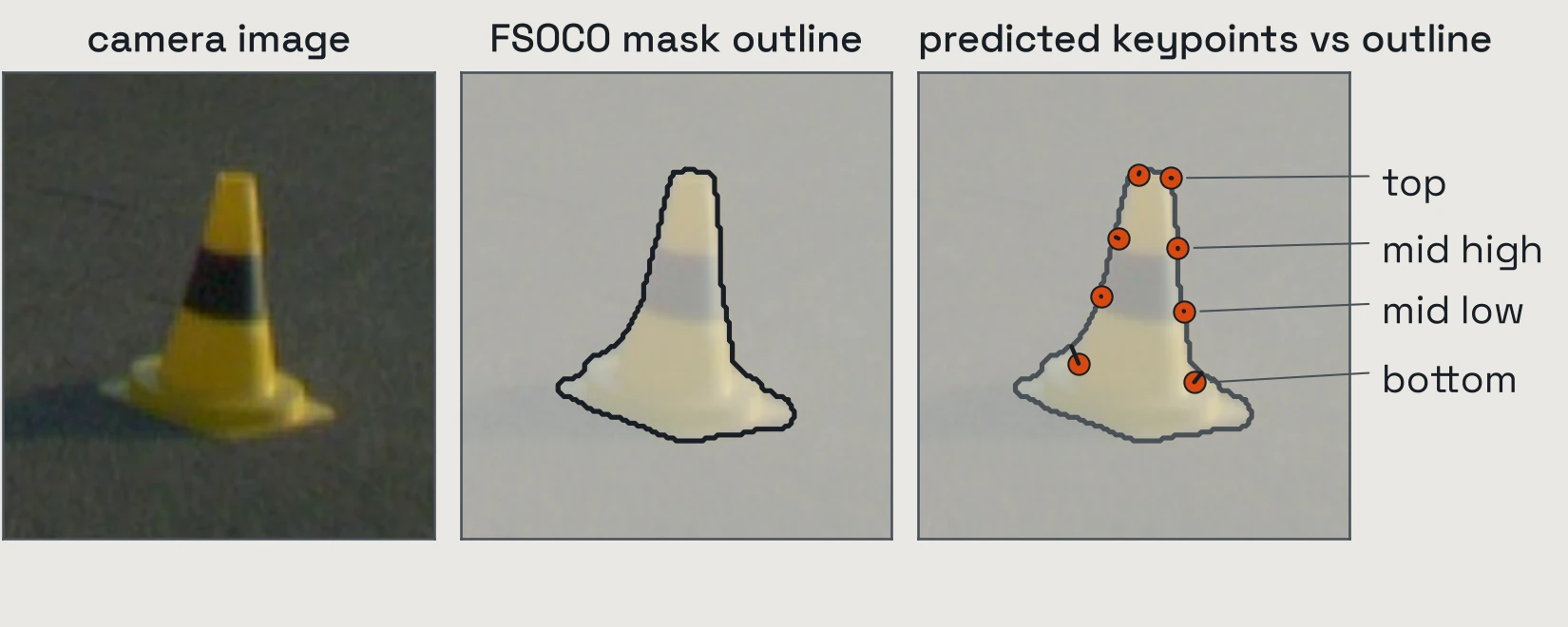
One cone's keypoints, scored against its mask outlineSourceCone-Pose-Validation, FSOCO images Evaluation without new labels, on a public dataset
A keypoint detector validated from existing segmentation masks, with no new labels
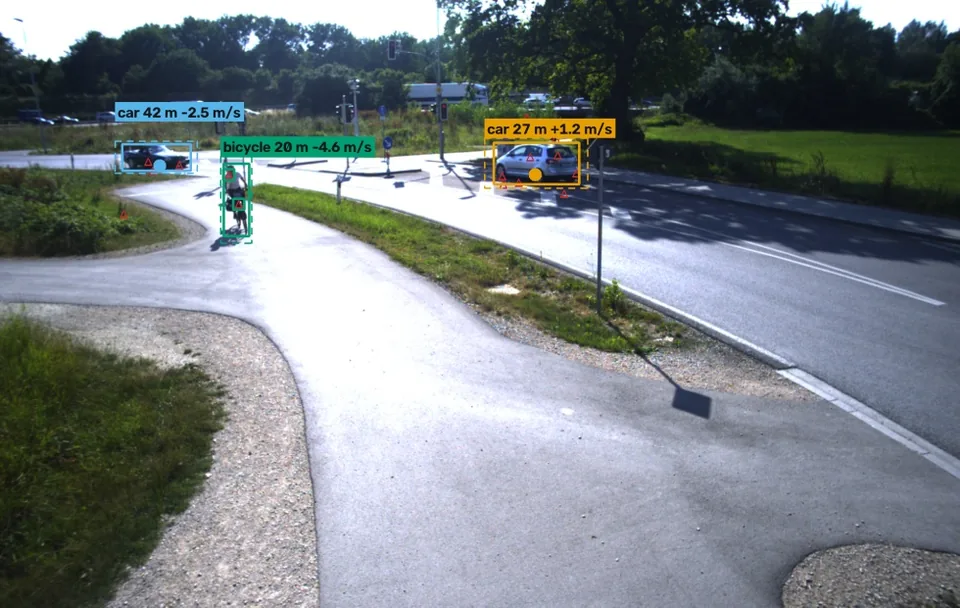
Fusion and tracking, camera viewSourceSensor-Data-Fusion, 2026LicenceINFRA-3DRC by Fraunhofer IVI, CC BY-NC 4.0 Fusion and tracking, measured on public recordings
Camera-radar fusion and tracking on real roadside recordings
